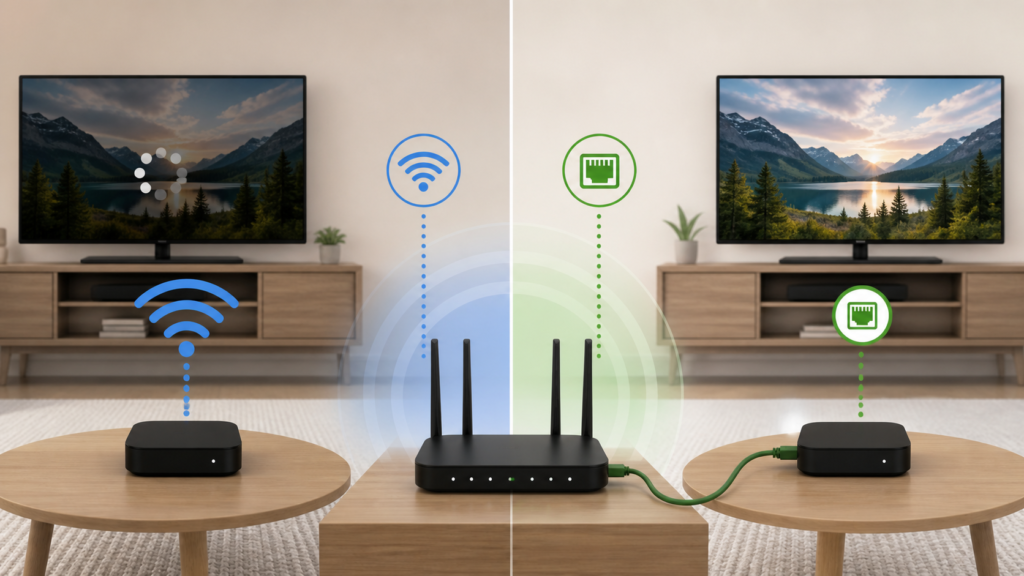
Quick answer: Wi-Fi and Ethernet can both work for IPTV, but the better choice depends on the device, room layout, router position, cable availability, and household network. Wi-Fi is convenient and avoids a cable run; Ethernet can provide a more direct and consistent path when the device and adapter support it. Test the actual player device with one connection at a time rather than assuming a connection type guarantees playback quality.
The comparison is most useful when IPTV buffers, the device is far from the router, or several household devices share the wireless path. A network choice will not correct a wrong login, empty playlist, unsupported player, or black video output. First identify the symptom and the device that runs the player.
What matters when choosing Wi-Fi or Ethernet for IPTV?
Check the distance between the router and the player, walls or cabinets in the path, available Ethernet ports, device adapter support, and whether the player is built into a Smart TV or runs on an external box. Our IPTV devices guide helps locate the network connection that matters.
Do not publish Wi-Fi passwords, network names with sensitive context, private playlist URLs, or account details. For a useful test record, note the device, connection type, time, affected item, and whether another permitted app behaves similarly.
Wi-Fi for IPTV: strengths and checks
Convenience and room flexibility
Wi-Fi avoids running a cable across a room and can be practical for a television that is not close to the router. It also makes it easier to move a supported streaming device between rooms. The tradeoff is that the wireless path can be affected by distance, walls, interference, device placement, and other household activity.
Check the actual signal path
Confirm that the player device is connected to the intended home network. Test from its normal location and compare the result closer to the router only as a diagnostic. Do not treat a closer location as proof of a permanent solution. Keep the device away from unnecessary obstructions and heat.
Separate Wi-Fi issues from player issues
Open another permitted app and compare one permitted IPTV item. If everything struggles, investigate the network path. If other apps work but a playlist, login, or one source fails, focus on the player and setup. Review the internet settings guide for broader checks.
Ethernet for IPTV: strengths and checks
A direct wired path
Ethernet can reduce dependence on the wireless path when the streaming device and network equipment support a compatible connection. It is often useful for a fixed television near a network point. The cable itself still needs a safe route, a working port, and a stable connection.
Check device and adapter support
Some Smart TVs and streaming sticks need a compatible adapter or hub. Confirm support before buying hardware. Connect one cable path, verify that the device reports Ethernet, and test another permitted app before opening the IPTV player.
Do not assume wired means every problem disappears
Ethernet cannot fix a wrong player field, login rejection, empty playlist, unsupported format, overheating device, or video-output mismatch. If the same IPTV symptom occurs on both connection types while other apps work, the network may not be the first cause.
How to compare Wi-Fi and Ethernet for IPTV
Step 1: Choose one device and item
Use the same player device and one permitted item for both tests. Record the time, connection type, whether playback starts, and when buffering or errors appear. Changing the device and network at the same time makes the comparison inconclusive.
Step 2: Test other apps
Open another permitted app on the same device before and after each connection change. This shows whether the device’s overall network behavior changed or whether the symptom stays limited to the IPTV player.
Step 3: Test Wi-Fi in the normal room
Use the player in its normal location with the usual TV and device placement. Do not move the router or change several wireless settings during the test. Note whether buffering is immediate, intermittent, or absent.
Step 4: Test Ethernet safely when supported
Connect the compatible cable or adapter, confirm the device switched to the wired path, and repeat the same item. Keep the cable away from walkways and heat sources. If the device remains on Wi-Fi, the comparison has not actually tested Ethernet.
Step 5: Interpret the result carefully
If Ethernet changes the symptom while Wi-Fi does not, investigate the wireless room path or choose the practical wired setup. If both behave the same, focus on the player, source, device, or another layer. If only one item fails, keep the issue source-specific.
Step 6: Keep the chosen setup stable
After selecting a connection, avoid changing router, DNS, player, and device settings at the same time. A stable troubleshooting record helps support understand what was tested. Use the IPTV service information for compatibility questions.
Common Wi-Fi and Ethernet questions
Wi-Fi works in the same room as the router
That suggests the normal room path may be different. Compare placement, walls, interference, and device location without treating the closer test as a guarantee.
Ethernet connects but IPTV still buffers
Confirm the device is actually using Ethernet, then separate buffering from player, source, storage, heat, and compatibility symptoms.
Only the TV has problems
Compare the TV or streaming device with another supported device on the same network. The player platform may be the differentiator.
Several household devices struggle
Investigate the wider network path and time pattern. Keep passwords private and avoid claiming a measured speed without evidence.
When to contact IPTV support
Contact support when a controlled Wi-Fi/Ethernet comparison is complete, other apps behave normally, and the same supported player symptom remains. Use the IPTV support hub and existing WhatsApp or official Telegram buttons. Share the device, player, connection type, item scope, timing, and non-sensitive tests. Never send passwords or private URLs.
FAQ
Is Ethernet better than Wi-Fi for IPTV?
It can provide a more direct path for a compatible fixed device, but the best choice depends on the home layout, hardware, and tested result. Neither guarantees a particular outcome.
Can Wi-Fi cause IPTV buffering?
Distance, walls, interference, placement, and shared wireless activity can affect a player. Compare the normal room with a wired path when supported.
Why does Ethernet not fix my IPTV problem?
The cause may be login, playlist, player compatibility, source behavior, storage, heat, or video output rather than the connection path.
What should I send support?
Send the device, player, connection type, affected item, timing, and non-sensitive test results. Do not send passwords or private URLs.
Final checklist
Identify the player device, compare another app, choose one permitted item, test Wi-Fi in the normal room, verify Ethernet when supported, change one variable at a time, and interpret the result by symptom scope. Keep network choice separate from login, playlist, buffering, and display issues. Use the services page and official support for compatibility questions.
{“@context”:”https://schema.org”,”@type”:”FAQPage”,”inLanguage”:”en-US”,”mainEntity”:[{“@type”:”Question”,”name”:”Is Ethernet better than Wi-Fi for IPTV?”,”acceptedAnswer”:{“@type”:”Answer”,”text”:”It can provide a more direct path for a compatible fixed device, but the best choice depends on the home layout, hardware, and tested result. Neither guarantees a particular outcome.”}},{“@type”:”Question”,”name”:”Can Wi-Fi cause IPTV buffering?”,”acceptedAnswer”:{“@type”:”Answer”,”text”:”Distance, walls, interference, placement, and shared wireless activity can affect a player. Compare the normal room with a wired path when supported.”}},{“@type”:”Question”,”name”:”Why does Ethernet not fix my IPTV problem?”,”acceptedAnswer”:{“@type”:”Answer”,”text”:”The cause may be login, playlist, player compatibility, source behavior, storage, heat, or video output rather than the connection path.”}}]}
Expanded diagnostic framework for Wi-Fi versus Ethernet for IPTV
This expanded section is designed to make the troubleshooting process more reliable for TV box or Smart TV. The important principle is to identify the layer that is failing before changing account or player settings. A visible symptom can come from the device, local network, application, stream data, or television output. Treat each layer as a separate test. This prevents a common mistake: reinstalling an application when the actual problem is a weak connection, or changing display settings when the stream itself is unavailable.
Record the starting condition
Before changing anything, note the exact symptom, the program or screen where it appears, the device model family, whether the connection is wired or wireless, and whether other applications behave normally. Record the application name and version if visible. This information is useful because a problem that affects every program is different from a problem limited to one stream. It also makes a support conversation shorter and more accurate. Never include passwords, private playlist addresses, access tokens, payment details, or full account screenshots in a public message.
Run one controlled test after each change. For example, first restart the player, then test the same program. Next test another program, then compare a second application. If several settings are changed together, you will not know which one helped and may accidentally create a new issue. Restore a setting when a test has no benefit, especially for picture mode, audio output, router security, or device language.
Separate device, network, app, and content causes
A device-level issue usually affects more than one application or appears immediately after standby, a system update, or a power interruption. A network issue often affects loading, guide data, images, and playback together. An application issue may be limited to one player while browsing and other streaming apps remain stable. A content or metadata issue follows one channel, program, guide entry, language track, or playlist item across repeated tests. This simple classification is more useful than assuming every IPTV symptom has the same cause.
For a quick comparison, open a normal web page or another legitimate streaming application. If the second application also fails, focus on the device connection and router. If everything else works, review the player cache, preferences, supported format, and session state. If only one program is affected, test another program before resetting the application. A single unavailable item should not be used as proof that the entire service or device is offline.
Safe restart and update order
Close the player completely and reopen it. If the device offers a force-stop function, use it before a full restart. Restart the streaming device from its system menu rather than only switching off the television panel. For network-related symptoms, restart the modem or gateway first, then the router, and finally the streaming device. Allow each device to finish its normal startup sequence. Install updates only through the manufacturer’s settings or the official application store. Avoid unknown packages, modified applications, and utilities that promise to unlock content or bypass provider controls.
Clear cache before clearing application data. Cache clearing can remove temporary files while preserving setup preferences. Clearing data may remove legitimate configuration and require the authorized setup process again. If a reset is unavoidable, make a note of the original app name, device settings, and supported connection method first. A factory reset should be a last resort and should follow the manufacturer’s documentation.
Practical verification checklist
- Confirm the device date and time are automatic and correct.
- Check that the device is connected to the intended private network, not a guest network.
- Test a second program or channel to identify whether the issue is isolated.
- Compare the same player on another supported screen only when you are authorized to do so.
- Review application cache, normal updates, and available playback settings.
- Test the television’s built-in speakers or direct display output when external equipment is involved.
- Keep a short record of each test and its result.
- Contact support with the symptom and device details, never with secret credentials.
When the first fix does not work
If the symptom returns after a temporary improvement, look for the condition that triggers it. Does it happen after standby, after changing programs, only at a certain time, only over Wi-Fi, or only with an external soundbar? A repeatable trigger is valuable evidence. Check device ventilation, cable seating, signal strength, available storage, and whether the application is competing with another network or VPN profile. Do not make permanent router or security changes without understanding their effect on the rest of the household.
For supported setup guidance, visit the IPTV service guide, review the services page, and return to the homepage for the main support path. If you need help, use the existing WhatsApp button or the official Telegram support group. Describe what was tested and what happened. A technician should not need your password to begin diagnosing a device, network, or playback symptom.
FAQ about Wi-Fi versus Ethernet for IPTV
Should I reinstall the IPTV app first?
No. First test another application, another program, and the device connection. Reinstallation is appropriate only when the device is online and the problem is limited to damaged or misconfigured application files.
How do I know whether the stream or device is responsible?
Test a second program and, when appropriate, a second supported device. A symptom that follows one program suggests stream data or metadata; a symptom affecting every application suggests the device or network.
Can changing DNS, picture mode, or audio mode fix every IPTV issue?
No. These settings address specific layers and should be tested only when the symptom points to them. Change one setting at a time and keep the original value recorded.
What details should I send to support?
Send the device type, player name and version, connection type, exact symptom, approximate time, and the tests already completed. Do not send passwords, tokens, private URLs, or sensitive payment information.
Final quality and trust notes
A reliable troubleshooting article should explain both what to do and why the step matters. It should distinguish observed behavior from assumptions, avoid unsupported performance promises, and give readers a safe stopping point. If a step risks deleting settings or weakening security, the reader should be warned before taking it. These practices make the guide useful for beginners while still giving experienced users a structured way to isolate the fault.